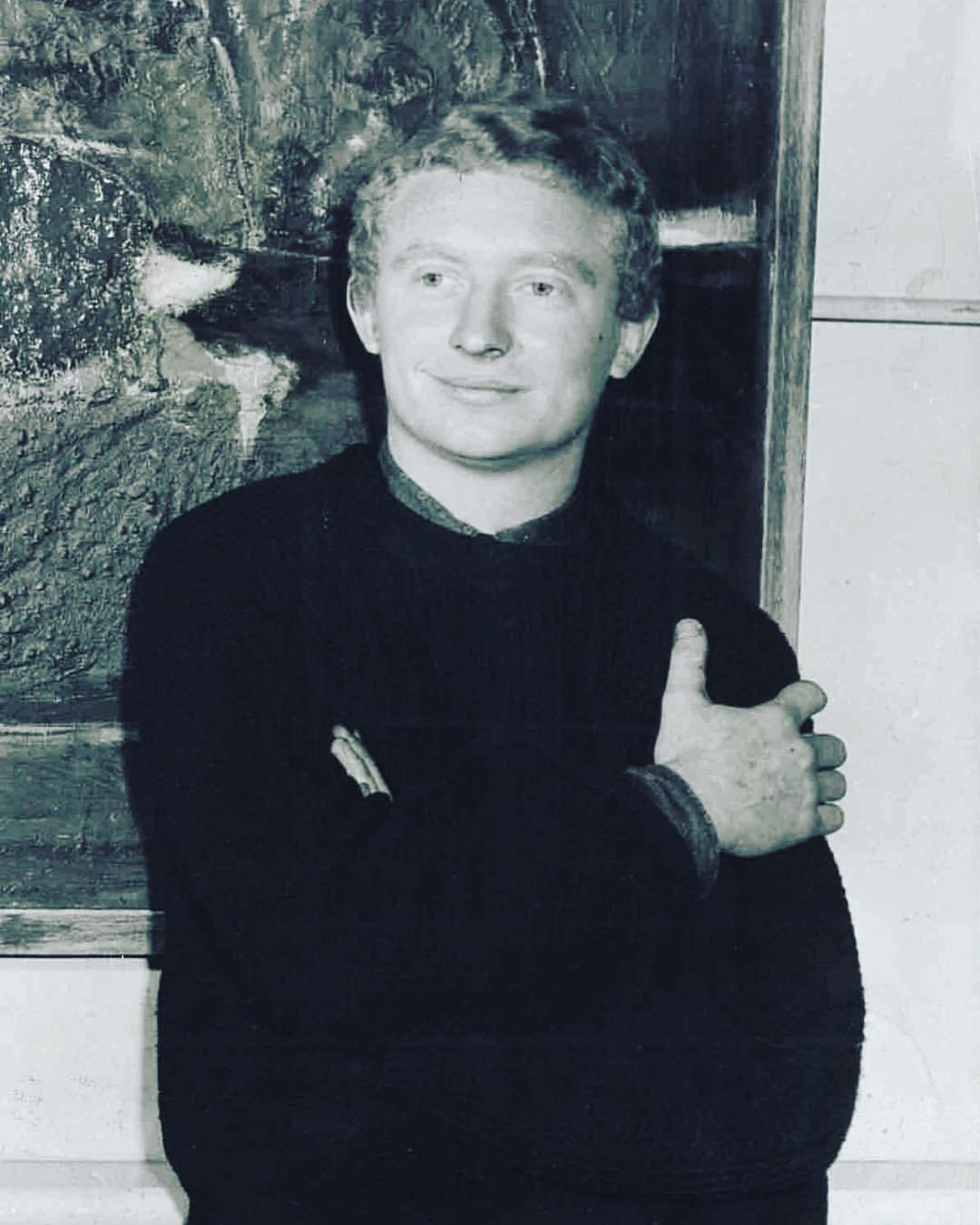
Bringing together the practices of Peter Godwin, Sally Anderson and Ross Laurie, Holding Light considers the ways in which perception, memory, and material sensitivity converge in contemporary painting. Across three distinct practices, light emerges not simply as a visual phenomenon, but as a conceptual and emotional register—something held, diffused, and translated through gesture, surface, and duration.
Peter Godwin’s practice is grounded in a physical and process-driven engagement with paint. His works are constructed through layered gestures that accumulate, obscure, and reveal in equal measure. There is a palpable tension between control and spontaneity, as marks are reworked and surfaces carry the trace of their own making. In Godwin’s paintings, light is embedded within the material itself—caught in the density of pigment, or emerging through abrasion and removal. The result is a dynamic interplay between presence and erasure, where the act of painting becomes a means of holding and releasing energy across the surface.
Sally Anderson brings a heightened sensitivity to perception and nuance, distilling her observations into compositions that feel both immediate and personal. Her works are characterised by shifts in tone and colour, where light operates as a structuring force—defining relationships between form, space, and atmosphere. Anderson’s paintings possess a quiet intensity, inviting close looking and an attunement to the delicate balance of elements within the frame. Rather than asserting themselves, they unfold gently, revealing the complexity of seemingly minimal means.
Ross Laurie’s paintings exist in a space of quiet suspension, where forms hover at the threshold of visibility. Laurie allows images to emerge gradually, as though recalled rather than observed. His surfaces are carefully modulated, with areas of opacity and translucency that create a sense of depth without relying on fixed spatial cues. Light, in Laurie’s work, is not descriptive but atmospheric—an internal presence that lends weight to absence and invites a contemplative mode of viewing. The paintings unfold slowly, rewarding sustained attention and a willingness to dwell within ambiguity.
In Holding Light, these three practices converge around a shared concern with the transient and the intangible. Light becomes a metaphor for the fleeting nature of experience, as well as a material condition that shapes the act of painting itself. Each artist approaches this condition differently—through dissolution, accumulation, or refinement—yet all are engaged in a process of translation, seeking to hold something that is inherently unstable.